
By Mikelann Valterra, MA, AFC®
Would a nicer house and new car make you happy? The answer is likely yes, particularly if your current house is getting too small for your family and your current car isn’t as reliable as it once was.
But does money have the power to make you happy?
The answer is: yes. And then no.
What?! Up to a certain point, more money DOES bring more happiness. And then no, after a certain point, it does not. Where is that point? Let’s find out.
We have all heard of Maslow’s hierarchy of needs, right? This is related to “need theory”. According to Maslow’s hierarchy of needs, we must have our basic needs met before moving forward to self-actualization and greater happiness. Generally, basic needs are considered food and shelter. Then safety, security, and health. Next comes the need to belong (be part of a family or community). Towards the top we need self-esteem and a sense of purpose. And of course, we all want to be towards the top of this hierarchy of needs. This is where happiness really begins to flourish.
When you are towards the bottom of a “needs hierarchy”, and you don’t have your basic needs met– you don’t feel safe and secure– then more money absolutely will help you feel better and fuel your well-being. Driving a car that doesn’t chronically break down DOES relate to wellbeing. Healthy food? Yes. Stable and secure housing? Money helps with these important needs, and it DOES impact your level of happiness. But now notice that the further up you go, the less money has to do with the hierarchy. Friendship, love and self-actualization do not require money.
Can money continue buying happiness at the higher levels of Maslow’s hierarchy?
The studies say no. In fact, there is a famous and oft-cited study out of Purdue that says earning above $95,000 per year (at 2018 values) would not lead to an increase in well-being. You can argue with this number and say that it depends on where one lives, and how big their family is etc. etc. All true. But don’t miss the point of this important study—there is a point beyond which more money does not equal more happiness.
That point may be different for different people/cultures etc., but the important point remains—beyond a certain level of money, acquiring more money does not bring more happiness. In fact, some studies suggest that you start getting diminishing returns. It takes too much energy to sustain a high lifestyle etc.
One key to being happier, and not having it connected to how much money you have, is to focus more on meaning than “happiness”. Why is this? Because meaning is enduring.
One of my favorite books of the last few years is Bruce Feiler’s Life is in the Transitions. In it he talked about a landmark 2013 study, where it was found that meaning trumps happiness. Says Feiler, “Happiness is fleeting while meaning is enduring; happiness concentrates on the self while meaning concentrates on things larger than the self; happiness focuses on the present while meaning focuses on stitching together the past, present, and future.”
Happiness is about immediacy. It is about pleasure. Pleasure is wonderful and we all want it. This is found in the lower levels of the needs hierarchy, and is super important. I feel pleasure at good food, good sex, a car I love, etc. But meaning is more about deeper fulfillment that comes from pursuing meaningful activities. It is about purpose and connection to others. And it is found in the higher levels of the needs hierarchy.
I agree we need both happiness—pleasure—AND meaning. Money will definitely help us lead lives where we are well cared for. But it cannot take us to the higher levels of fulfillment, where a deep sense of meaning is found and felt.
Having a conscious relationship with money and using it to create a solid base in our lives is important. But past a certain point, its only purpose lays in supporting us as we move on to higher levels of life satisfaction.

 By Mikelann Valterra, MA, AFC


 By Mikelann Valterra
 By Mikelann Valterra
 Great news! My new book Rise Above the Money Fog, the key to confidence, clarity, and control over your life, launched this week on Amazon. I am happy to say it earned the top new release in both Amazon’s finance category AND women and business! Wow. I am over the moon. I want to thank everyone who has purchased a copy and a special thank you to the readers who shared their reviews on Amazon. It feels so good to see this book in the world, after a lot of hard work. At only 100 pages, it is short but powerful. May it help women rise above the money fog and step into their true potential!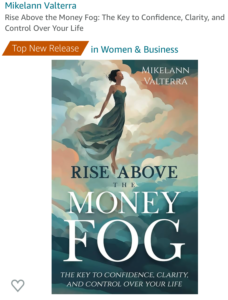

 At fifty-one, Christine was tired of being stressed about money.
 It’s not your imagination—most of us grew up hearing very little about money. The result of this childhood omission is… the money fog.
 I was honored to be interviewed by Suggest Magazine recently, on what to do about “financial trauma”. A large portion of their audience is Gen X Women and being one myself (Generation X is born between 1965 and 1980), we talked about this in particular. Gen X women are used to doing it all themselves– we were the “latch key generation” — and this is both good and bad when it comes to money…
 Dare I say there is a silver lining to divorce? Well, there is. You get a fresh start in so many ways. And your relationship with money is one of these “fresh start opportunities”.