
 Recently, I went to a large chain bookstore and stood in front of several shelves of business and career development books. From how to write your resume to how to decide what you want to do with your life, it was all there. Everything, that is, except money.
I grabbed a pile of the most promising career/ professional development books and sat down to study their indexes, looking for the chapter in each book where they talked about money. You know—how much money you wanted to make and how much various careers paid etc. I found nothing. The closest thing was the perfunctory chapter on salary negotiation. There was nothing on deciding how much you wanted and needed to make, and nothing on how to match your income desires to different careers. There was nothing on the financial pros and cons of various fields and no talk of the incredible wide discrepancy in pay between fields.
What did I find?
Personality profiles. All the career development books were devoted to helping you analyze your personality and then find a good match with a satisfying career. Now mind you, I am not saying that a good match is not important. It is incredibly important. You spend far too many hours working to not enjoy what you do. But money is incredibly important as well. It is one of the main reasons people work in the first place! And yet it is hardly even mentioned in the many books designed to help you find the right “match”!
One of the better books out there on job change is the annual updated What Color is Your Parachute series. This series is about how to do a “life-changing job hunt”, and is full of useful and practical information on how to job hunt in real life, using what Richard Nelson Boyles and Katharine Brooks describe as non-traditional techniques. (For example, they think that resumes do very little to help us land the next job.)
In their annual edition, they list out the most common reasons that people pursue a major change in their career. I was fascinated to see that only one had anything to do with money and compensation. It seems as though work is rarely related to money, and I believe this “disconnect” has far reaching repercussions for everyone, but especially women. As you’ve seen, a life time of not earning at one’s potential, of not really taking one’s earnings seriously or trying to maximize what one can earn in a given position, wreaks havoc on your future financial stability. And I can virtually guarantee you that the person you will be in thirty years is going to wish you had paid more attention to this whole “money” thing, in the present.
The disconnect in our schooling
As I mentioned, the disconnect between work and money starts even earlier then when we enter the job force. It starts in school, where money is rarely acknowledged or discussed.
Why does no one ask us when we are in school how much money we would like to make? It seems almost a crass question, so it is rarely, if ever, brought up. And since it is not brought up in the schools, people generally do not bring it up themselves. A school’s silence on making money somehow sanctions ones continued reticence in asking the question ourselves.
Even when we are growing up, most girls dream of doing many things, but very few of them envision how much money is attached to these fantasy occupations. There is still an ingrained sense of reliance on something outside themselves. Women do not have the basic assumption that it will be up to them to take care of both themselves and a family. Therefore, they have the luxury of not thinking about this whole money thing.
But what if we did think about it?
What questions would we ask ourselves? Perhaps we could start by asking how much money we would like to earn someday. Then when we are in school we could ask questions like,
“How much money could I expect to make if I study this”?
This single question is so important, yet it is almost never asked. Women pay a high price for not asking questions like these. Years later, after decades of low earnings, they may wish they had asked themselves more questions.
Ready to earn more and step into greater freedom? Click here to be notified of the next time Mikelann offers her 8 week Unlock Your Earning Power course.






 I am thinking a lot about foundations- literally. I am in the process of building a second home that I will rent out. (I’ll write future posts on alternative ways to think about retirement, income streams and going “work optional”. Once you are in command of your money, there are many ways to do it.)
 I wanted to share some additional thoughts to my previous post on my work with couples and money.
 It was 20 years ago that I started my own journey of Financial Recovery.
 I’m often asked for book recommendations to read as part of your money journey. So below are three wonderful books that get to the heart of your relationship with money. They are not just about the practical side of money, with advice on debt and savings, but rather, they all go much deeper into the emotional and spiritual sides of money. All three of these women are trusted colleagues of mine. I’m quoted in Karen’s book, I’ve been cited in various books by Barbara (and even contributed to one of her anthologies) and Bari has had me both teach for her and has interviewed me. I say this not to brag, but to let you know how well I know and trust their work. These books cover everything from how you were raised with money and your “money story”, to getting to the root of overspending and underearning. They are each an odyssey of personal growth and will move you forward.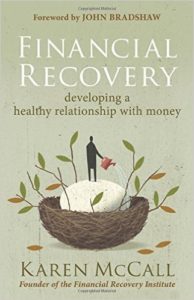


 It’s a bright shiny New Year, and I bet you’ve heard many versions of “New Year, New You.” So—is this year the year to shift your relationship with money? Here are three steps to contemplate, so you decide if this is the year to make the shift.